Wholesale Clothing Minimum Orders: What's Normal and How to Negotiate
Wholesale Clothing Minimum Orders: What's Normal and How to Negotiate
You found a supplier you like, the line sheet looks great, and then you hit the fine print: a minimum opening order that's bigger than your whole launch budget. For a new boutique or reseller, the wholesale clothing minimum order can feel like a locked door.
It's less rigid than it looks. Most minimums come from real costs, not stubbornness, which means there's usually room to talk. Below is what's normal by vendor type, why the numbers exist, and how small buyers get first orders that fit their budget without burning the relationship.
What a wholesale clothing minimum order actually means
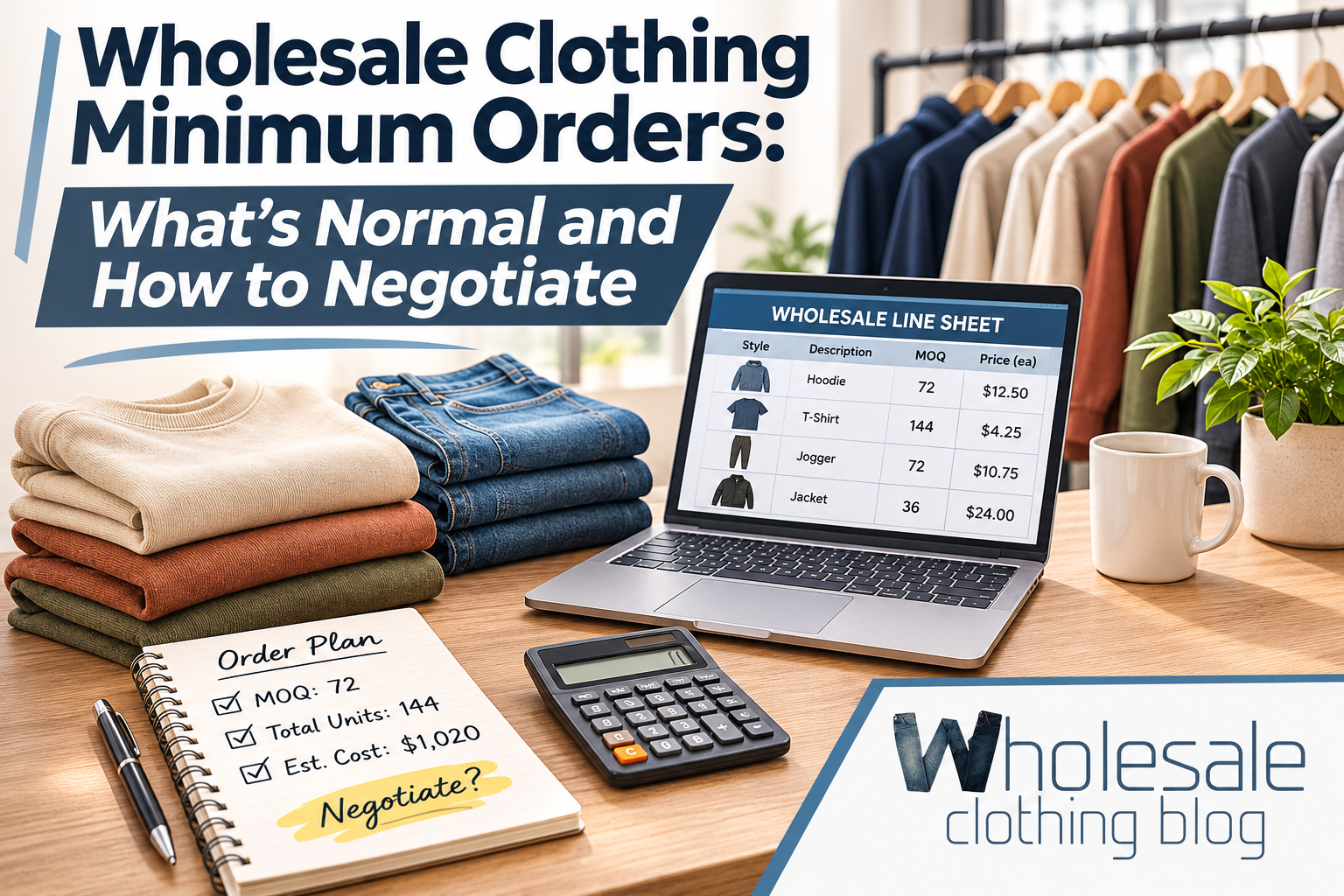
"Minimum" is not one thing. Vendors set it in a few different ways, and you need to know which one you're dealing with before you compare prices. A dollar minimum is a total cart value, like $250 or $500. A unit minimum is a piece count, like 24 pieces across the order. A per-style minimum requires a set number of each item, often a full size run or a pre-packed bundle such as 6 pieces in a 2-2-1-1 size split.
Some vendors stack these, asking for a dollar minimum and a per-style minimum at once. Many also split their rules into an opening order minimum and a lower reorder minimum. That distinction matters because a high first-order hurdle can be the price of entry, with easier terms once you're in.
If you're still getting oriented on accounts, paperwork, and how ordering works from start to finish, our wholesale buying guide covers the groundwork so these terms don't catch you off guard.
Typical minimums by vendor type
These are typical ranges, not rules. Every vendor sets its own, and they shift by season and category. Use them to sanity-check what you're quoted.
Independent brands selling direct: often $150 to $500 for an opening order, sometimes with a piece minimum of 6 to 12 total. Small labels usually have the most flexibility because the owner is making the call.
Wholesale marketplaces: each brand sets its own minimum, and many land in the $100 to $300 range. Some offer a discount or free shipping on a first order as an incentive, which can soften the hurdle.
Distributors and jobbers: commonly $100 to $300, or a single case or pack of an item. They stock many brands and move volume, so their minimums tend to be the friendliest for testing.
Importers and factory-direct sellers: typically the highest, often $500 to $1,500 or more, or a set quantity per style such as 50 to 100 pieces. You get lower unit costs, but you carry more risk.
Closeout and liquidation lots: sold by the lot, case, or pallet instead of by the style. The cost per piece can be very low, but you're buying what's in the lot, so sizes and mix are less predictable.
Why vendors set minimums, and where they bend
A minimum protects the vendor's margin. Picking, packing, invoicing, and shipping a $60 order costs nearly as much as handling a $600 one. Factories add another layer: fabric mills and production runs have their own minimums, so the vendor passes that pressure down to you.
Knowing this tells you where the flexibility is. Vendors bend when the order is easy to fulfill, when it comes with prepayment or clear intent to reorder, or when the stock is something they want to move. They rarely bend on things that raise their cost, like custom production, special packaging, or splitting a case they've already broken down.
In other words, the best question isn't "Can you drop the minimum?" It's "What would make a smaller first order work for you?" That puts you on the same side of the table.
Tactics to get a lower opening order
Just ask, and be specific. Send a short note that says who you are, what you sell, and what you'd like to order. Vague requests get template replies. Something like "I run a small women's boutique and would like to start with $200 across four styles" gets a real answer from a rep.
Ask about the opening order separately from reorders. Many vendors will quietly lower the first-order bar for a new account if you say you plan to reorder what sells. A trial order costs them little and can turn into a long-term customer.
Offer to prepay. Paying by card or upfront removes their payment risk. For a new account without trade references, that can be the difference between a yes and a polite no.
Mix styles to hit the dollar minimum. If the minimum is by total value, not per style, build the order from a few low-priced basics and a couple of statement pieces. You reach the number while spreading your risk.
Ask about pre-packs versus open sizing. Pre-packs are cheaper to fulfill but lock you into sizes you may not need. If the vendor allows open sizing at a slightly higher piece count, you can match your actual customer.
Buy late in the season. End-of-season and overstock inventory often comes with more flexible terms, because the vendor wants space for the next collection.
Split an order with another shop owner. Two small buyers can combine into one order to clear a minimum, then divide the shipment. Check that the vendor is fine with a shared ship-to, and settle who pays what in writing before you submit.
A worked example with made-up numbers
Say you're launching with $800 to spend on inventory and want to test three suppliers. Supplier A has a $500 minimum, Supplier B has a $250 minimum, and Supplier C has a $150 minimum but sells by the case. Spend at A and you've used most of your budget on one bet. This is an example , not a prediction, but it shows why a lower wholesale clothing minimum order is worth chasing even if the per-piece price is a little higher.
Now suppose you really want Supplier A's line. A short message might read: "We're a new boutique and love your line. Our budget for a first order is closer to $300. Would you consider a trial order at that level if we prepay and plan to reorder core styles after we see sell-through?" The worst case is a no. The likely case is a counteroffer, maybe a $350 first order, or a lower minimum on a selected group of styles.
If they say no, thank them and ask to be put on their list for next season. Staying friendly costs nothing, and vendors often revisit terms when a buyer comes back.
Don't trade a low minimum for a bad supplier
A very low or nonexistent minimum can be a red flag when it comes with vague product details, stock photos that don't match samples, or no clear return and shipping terms. Before you send money, run the supplier through the checks in our post on how to vet a wholesale clothing supplier before your first order.
Ask for a sample or a small test order, confirm lead times in writing, and look for real customer feedback outside the vendor's own website. A $200 minimum from a reliable supplier beats a $75 minimum from one that ships late or sends the wrong sizes.
Size your first order so it can actually sell
The minimum is only half the math. What matters is whether you can sell what you buy at a price that leaves a margin. Work backward: decide how much cash you can tie up in stock, estimate how many pieces you can realistically move in the first two months, and compare that against what the vendor requires.
If the minimum is higher than your sell-through estimate, don't stretch to fit it. Pick a different vendor type, such as a distributor or marketplace, and use the first order to learn what your customers buy. Our Retail & Resale section goes deeper on pricing, margins, and building a product mix once the boxes arrive.
We write these guides from the practical side of running a shop. If you want to know who's behind them and how we approach sourcing topics, see about us.
Sarah’s Rule: Don't let a vendor's minimum set your budget. Spend only what you could realistically sell through at full price in the first 60 to 90 days, and find a vendor whose terms fit that number.
More Related Posts